Why We Preach

We preach because "Indeed, the word of God is living and active, sharper than any two-edged sword, piercing until it divides soul from spirit, joints from marrow; it is able to judge the thoughts and intentions of the heart." (Hebrews 4:12)

Sunday, December 25, 2011

The Reason for the Season


“Put the Christ back in Christmas!” “Remember the reason for the season!” “There’s a war on Christmas!”

Throughout the holiday season I've heard these sentiments touted over and over - there are even Facebook pages dedicated to these causes. There are obviously many who are worrying that the meaning of Christmas is being lost as it's replaced by the forces of political correctness.

Some complain that the word "holiday" is being used where “Christmas” properly belongs. And if we believe everything we hear from Christian alarmists, we might be easily convinced that the "true meaning" of Christmas is quickly fading in American culture.

And indeed, I would agree – I think there is something terribly wrong with the way in which we observe Christmas in this country.  In the midst of frantic shopping, the stress of travel, and the ever-present anxiety that always accompany family showing up for the big Christmas meal, I think we sense that something is askew. There's a disconnect behind how we celebrate and why we're celebrating.

Though I don’t think political correctness or the “non-Christian” culture is to blame.

I think it runs deeper. I think the problem lies not outside Christianity - but perhaps within it.

Sunday, December 18, 2011

Rapture In Reverse


Scripture: Revelation 21:1-7

This final week of Advent also marks our final week of our journey through the book of Revelation. And as I promised that first week – we end up pretty much right where we started. With Jesus saying to us once again, “I am the Alpha and the Omega, the beginning and the end.” We began by hearing the promises given to the seven churches, to those who conquer and overcome – that they would be given crowns, robes, and made pillars in the temple of God. And here we see the culmination – what those who “conquer” will inherit.

These past 7 weeks we’ve gone on a very “revealing” journey about our world – of where we are versus where God wants us to be. We’ve seen beasts, harlots, plagues, horsemen and countless other threats to our world, our livelihoods and our faith lives.  We have been called out of the evil systems of our world, called out of operating like the rest of the world operates, called to a life of faithfulness, called to renew our love for one another, called to hear the promises that we will be victorious if we can resist the seductions of evil around us.

And now, at the end of the book – we are being invited in and given a glimpse of God’s vision for our future.

As the conquering Word of God goes out and defeats the evils and threats we face on a regular basis, Revelation 21 and 22 invite us in to see what God envisions for our world. Invites us to see what heaven on earth will look like. Invites us to see how what we pray each week will become a reality.  “Thy kingdom come, thy will be done, on earth as it is in heaven.”

Revelation has not been about rapturing us up into heaven so we don’t have to face the ugliness of our world - but rather delivers to us a promise that equips us to handle the ugliness and evil of the world around us.  Instead of sweeping us up into heaven to let the world just fend for itself and be destroyed – Revelation ends instead with God and his Kingdom DESCENDING, coming down to earth – coming down to us.

Tuesday, December 6, 2011

The Self-Destructive Nature of Evil


Scripture: Revelation 17

I remember one time when I was in seminary a Jehovah’s Witness came to my door wanting to talk to me about the book of Revelation. They were determined to show me the error of my Lutheran ways, and wanted to use Revelation 17 to do it.

They asked me, “Do you know what the Harlot is?” I said, “Ummm, a great city?”

“Oh no! Revelation 17 tells us that it’s following a false religion.”

I responded with… “Oh? Really? Ok, let’s look it up…”  I then proceeded to read to them verse 18, “The woman you saw is the great city that rules over the kings of the earth…”

For some reason... they never came back to visit me.

People go a lot of different places with this imagery…

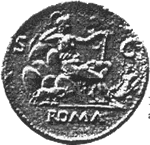
But if we go back to John’s day, we know that the image of a woman riding a noble steed was frequently used throughout the Roman Empire to symbolize the city of Rome.

In the case of Rome, they had coins that had the Goddess Roma… oddly enough leaning back against seven hills.

What John is doing is taking this well-known image and “revealing” its true nature.

John is using satire. He’s taking this familiar image, and making it into a caricature to say something about the nature of this so-called “noble woman” called Rome.


Sunday, November 13, 2011

Where Do YOU Stand?


The following is a continuation of our Revelation preaching series at First Lutheran. This sermon was preached by Pastor Meg Sander. 

Scripture: Revelation 6:1-8, 15-17; Revelation 5:1-8

There are many phrases we use that contain the word stand. STAND tall. Take a STAND, make a STAND! STAND by me. STAND by your man or woman. STAND up for yourself! STAND on your own two feet. STAND up and be counted. STANDing in the need of prayer. STAND up for your rights! If you don’t STAND for something, you’ll fall for anything! And at the end of our Bible reading for today…"Who is able to stand?” No one is able to stand when we look at what the text says.

There was a white horse…representing CONQUEST.  And another horse, bright red; representing VIOLENCE. Then there was a black horse, representing ECONOMIC HARDSHIP! And a pale  green horse representing DEATH!  And then later in the chapter we read that there came a great earthquake; the sun became black as sackcloth, the full moon became like blood, and the stars of the sky fell to the earth… Then the kings of the earth…the generals and the rich and the powerful, and everyone, slave and free, hid…for the great day of their wrath has come, and who is able to stand?’

Whoa! Hold your horses! In all that gloom and doom, you ask who is able to stand. Of course nobody is able to stand when they face all kind of destruction and despair. Are you kidding?  When left to our own defenses, we are unable to stand against the perils of this world.

Sunday, November 6, 2011

Christ & The Church: Problems of Assimilation, Complacency & Persecution

Scriptures: Revelation 1:4-19 (Daniel 7:9-14; Zechariah 12:10-11)

This week we’re starting something a little different than we’ve ever done before. We’re a Lutheran church… and we’re going to do a preaching series on the Book of Revelation. Bizarre… I know.

Its images and message have been interpreted in a variety of different ways and continue to be used as a “predictor” for current world events.

Where a lot of people go wrong when they open the Book of Revelation is they skip over this opening portion and tend to jump right into chapter six – where the four horsemen show up. After all – that’s when things get exciting.

But if you skip over this opening portion, you miss the entire point of the book of Revelation – because the opening is where we are introduced to the hero of the story. We are introduced to Jesus. A vision of Jesus that draws on and stays consistent with the Old Testament visions.

Sunday, October 9, 2011

Wearing Christ

Scriptures: James 2:14-19; Matthew 22:1-14

A week before my wedding, I suppose it’s only fitting that I get to preach on a parable about a wedding banquet. Hopefully I don’t have quite the difficulty in getting people to attend that the king does in this parable.

It really is an odd parable if you think about it. It would be like if you had been invited to Prince William and Kate Middleton’s wedding and every single person who had been invited went, “Nah. I have better things to do that day.”

But the parable’s meaning is pretty clear up until you get to one particular little point. The first part we get – Israel constituted the “special guests” but they rejected God’s Son and thus, didn’t RSVP. And in fact – killed God’s messengers. Similar to the parable last week of the tenants who killed the servants. So God invited everybody else.

Seems pretty simple. Until you get to this disturbing addendum to the parable about the guy who shows up and isn’t properly dressed for the wedding so the King kicks him out where there is “wailing and gnashing of teeth.”

Sunday, October 2, 2011

The Cornerstone

Scriptures: Matthew 21:33-46; Isaiah 5:1-7; Philippians 3:4-14

Every parable usually has one main overarching theme or message – to reveal to us something about the nature of God. Whether it’s the prodigal son showing us how God welcomes back the lost, or the parable of the Good Samaritan that tells us who God views as our neighbor.

And then you get a parable like this that makes you start going… “That landowner... he’s not too bright.” Albert Einstein once defined insanity as doing the same thing over and over, but expecting different results.

But that’s how this landowner acts. He keeps persistently sending servant after servant to these tenants, hoping that they will eventually do what they’re supposed to – then finally sends his son, who also is rejected, beaten and killed.

From a worldly perspective – we look at God and say, “Ummm, yeah – not the brightest move.” But on another level, it shows us the patience and persistence of God. How God continually keeps trying to bring his people around, to get his people to do what they were supposed to do – be a priestly nation to the world. His representatives to the other nations. He sends prophet after prophet – then ultimately he sends His son.

But they continued to refuse to bear the kind of fruit God was after.